Across the lifespan, humans don’t just learn new information and skills, they also develop entirely new ways of seeing and being in the world. This process does not stop when we reach adulthood, however, most individuals and training programs completely overlook this reality.
On their own, more skills and information will not save you. You need to simultaneously cultivate a different type of development in order to keep pace with the ever-complexifying world.
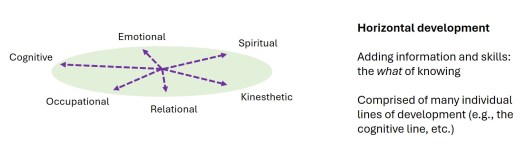
Horizontal development (“apps”)
When discussing these dimensions of human growth, it can be helpful to use apps and operating systems as analogies. You are well-aquatinted with the human equivalent of apps: these are the array of skills and capabilities that we possess and strengthen over time, sometimes with formal training. For example, you’ve likely attended A- and C-schools designed to increase your capacities in certain skillsets. You’ve also probably gotten better at being in relationships over the years just by keeping at it.
Each of these human apps represent unique lines of development that we can progress along towards greater and greater competency. In the space of human development, we call the growth of these skills and abilities horizontal development because each expands our base capability within the current operating system. This base reflects what we know and can do.
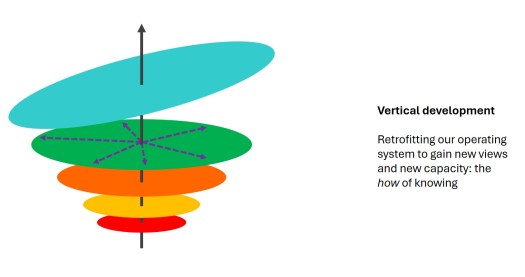
Vertical development (“operating systems”)
As in the digital realm, we can continuously update our human apps, but there’s a catch: we need an equally-capable operating system (OS) to get the most out of our app library. An OS can also be too underpowered for the demands placed upon it. You may not have thought of it this way before, but the frustrations and pain-points in your life can signal that your OS is struggling to handle the challenges you face at work and home.
Vertical development is the process of retrofitting our operating systems. We call this a vertical move because it fundamentally changes the way we experience ourselves and the world, and it gives us new perspective akin to that gained when climbing a ladder. Where horizontal development changes what we know, vertical development transforms how we know.
Imagine back to your childhood. At one time, you experienced the world as being full of magic—there were monsters under the bed, fairytales were real, and natural phenomena like the weather were governed by whatever rules you created in your mind. Child-you knew many facts and could do many things independently, but all of that knowledge and capability was fundamentally constrained by the magical, non-rational way you experienced the world at that age. To use another analogy, the constraints of your magical OS were like an irremovable pair of colored glasses that tinted everything you saw and did. At that point, you could not exchange the magical glasses for a set of rational-scientific glasses if you wanted.
And then a few years later, you could. It is perfectly natural for young children to experience the world via magical operating systems, and it is perfectly natural for adolescents to outgrow those and evolve ones that are more rational. But once again, the move is not simply about gaining new knowledge and skills: the move is actually about how a person’s relationship to knowledge and skills changes. That is vertical development, and the process does not end when we graduate high school. There are still further reaches of adult development.
Where coaching fits in
Think about how different the earth looks when you take off, go aloft, or ascend a mountain: entirely new vistas emerge and the limitations of your sea-level worldview become readily apparent. With physical elevation, you can perceive reality and drive action in more meaningful ways. Vertical development in humans is no different: it is the cultivation of higher stages of adult development that allows for more potent perception and action. In the long run, that might just lead to less suffering, too.
It is our human birthright to develop in the vertical dimension, but this evolution depends upon the right balance of challenge and support. On our own, most of us lack the targeted support necessary to accelerate this vertical movement. Enter developmental coaching…
 John M. Kopp