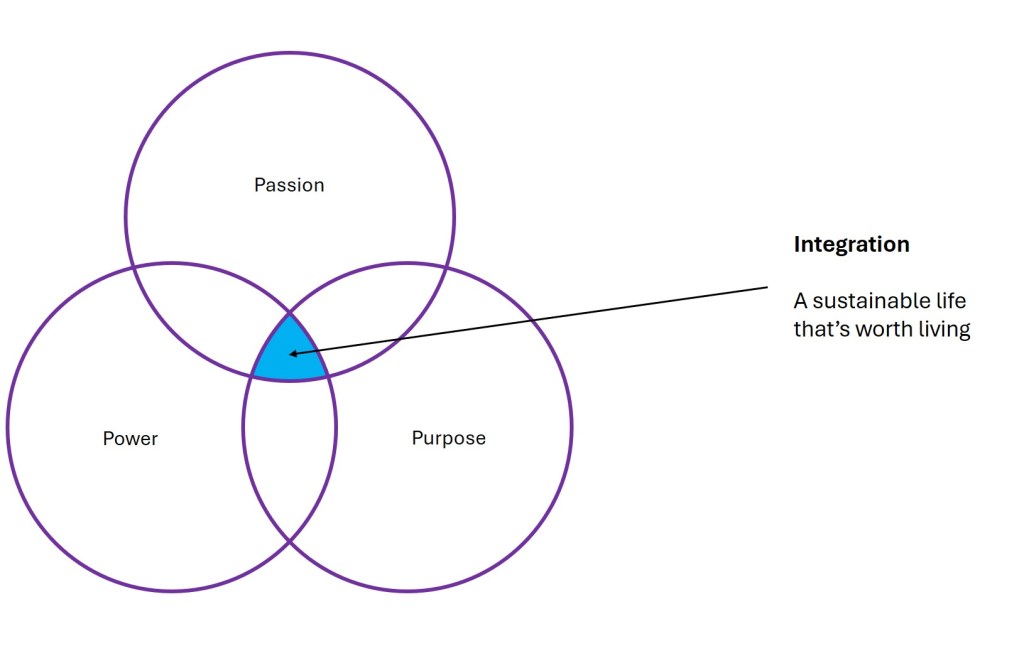
You’re likely exploring coaching because something in your life feels off. In addition to signaling developmental challenges, disillusionment and confusion can also be signs that passion, power, and purpose are misaligned in your life. When these three key variables come together in harmony, however, abundant life energy and fulfilment can arise for you in sustainable ways.
Passion
One philosophy of life suggests that every person comes into the world imprinted to be totally unique—to their deep fulfilment, or to their despair, depending on whether or not they are able to identify and actualize that which makes them exceptional. So, what lights you up? What do you long to do with your free time? What are you willing to die for (after all, we will all die having spent our lives doing something)? Conversely, what positively bores you or offends your soul?
Times when life-force gushes forth or dries up entirely can indicate where our unique passions do and do not lie. And according to this philosophy, the real juice of life comes from finding and following our passions; life’s barren spells arise when we’ve lost the trail. Depression, while painful, can be a sign of the latter.
Power
What are your practical, physical limitations in this moment? What is the current reach of your influence; in time, how do you expect this sphere to change? The military’s rank system provides some clear answers in terms of your current position and advancement potential, but the simple structure of this hierarchy does not dictate everything about what is possible for you within the USCG—and it generally doesn’t limit your reach outside the service, now or in the future.
When exploring life-alignment, power is a constraint that must be addressed. Like an aircraft’s performance characteristics, it delineates what is and is not possible for your “vehicle”—for you. Realistically, some possibilities lie far from reach and may require unsustainable commitment (few will become the commandant or MCPOCG, for example, though there are pathways to get there for a select few). In other cases, some doors may be permanently closed. Understanding where our power lies—and could lie—focuses our passion and purpose into a sustainable range that we can act on.
Assessing our power also functions like the third part of the popular Serenity Prayer: “grant me the serenity to accept the things I cannot change, the courage to change the things I can, and the wisdom to know the difference.” Paradoxically, a sense of peace—and even additional umph—can arise when we surrender to the constraints of our lives.
Purpose
Like passion, purpose is a subjective feeling. It is the sense we get when effort, suffering, and our very lives feel worth it. And like passion, the absence of purpose can create despair: what feels worse than pain without a purpose or a life without meaning?
Big questions come from the exploration of purpose. The Biggest questions, in fact: what am I living for, and what do I need to do before I die? We are peddled an ever-increasing array of catchy distractions, but none of them comes close to making one’s life feel meaningful, worth it. As is said in the context of addictions, it’s hard to be satisfied by something that almost works.
When we see through the false promise of today’s popular distractions, we may feel temporarily empty, but this is actually a positive sign. Emptiness of this sort means we have opened ourselves up to discover what truly matters and what contributes to a life that’s worth dying for.
Integration
You may have adequate power within the USCG to give your best gifts in service of deep purpose. Or you may not, and a vision for transitioning out might be necessary. Whatever the case, developmental coaching explores and integrates these three variables so that you can find your groove.
 John M. Kopp